Listening to the Past: How Israeli Museums Are Pioneering Audio-Driven Immersion
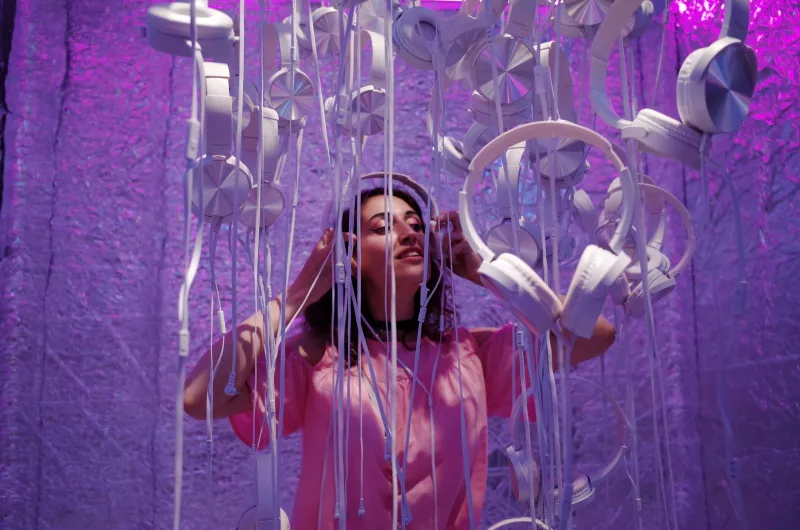
For most of the twentieth century, the museum experience was fundamentally a silent one. Visitors moved through galleries, reading placards and studying objects behind glass, their engagement mediated almost entirely by the eye. That model is changing—perhaps nowhere more ambitiously than in Israel, where a cohort of institutions is treating sound not as decorative backdrop but as primary historical evidence.
The implications extend well beyond aesthetics. When a visitor to a reconstructed Second Temple–era gallery hears the distant resonance of a shofar or the low hum of crowd noise approximating an ancient marketplace, something neurological shifts. Emotional engagement deepens. Retention improves. And the distance between observer and artifact quietly collapses.
Why Sound? The Case for Multisensory Curation
Cognitive research conducted over the past two decades has consistently demonstrated that memory formation is strengthened when multiple sensory channels are engaged simultaneously. Museums, historically oriented around the visual, have been slow to absorb this finding—but Israeli institutions have moved with notable speed.
Part of that urgency is contextual. Israel's cultural landscape encompasses an extraordinary compression of historical periods: Bronze Age settlements exist within walking distance of Ottoman-era architecture, which gives way in turn to mid-century modernism and contemporary urban culture. Communicating that density to an international audience—particularly American tourists accustomed to more linear historical narratives—requires creative tools. Sound, it turns out, is one of the most effective.
"You can show someone a clay oil lamp and explain its function," one museum educator in Jerusalem observed during a recent symposium on interpretive design. "But when you pair that object with the ambient acoustics of a first-century domestic interior—the creak of wooden beams, the murmur of Aramaic conversation—the lamp stops being an artifact and becomes a window."
Oral History as Curatorial Architecture
At several of Israel's Holocaust remembrance and immigration history museums, audio design has taken a particularly intimate form: the recorded voices of witnesses, survivors, and first-generation immigrants woven directly into the physical flow of gallery spaces.
Yad Vashem, Israel's central Holocaust memorial institution in Jerusalem, has long incorporated testimony recordings into its permanent exhibition. But recent renovations at a number of regional museums have pushed this practice further, positioning oral history not as supplementary content accessed through a headset kiosk but as the structural spine of entire gallery wings. Visitors move through rooms where voices seem to emanate from the walls themselves—a deliberate architectural choice that prevents the passive consumption that traditional audio guides can encourage.
This approach carries particular resonance for American Jewish visitors, many of whom arrive in Israel with family connections to the stories being told. The effect is not merely educational; it is, by design, visceral.
Reconstructed Soundscapes and the Question of Authenticity
Perhaps the most technically demanding dimension of Israel's audio innovation involves the reconstruction of historical soundscapes—acoustic environments calibrated to specific periods and places that no longer exist in audible form.
The challenge is considerable. Recreating the sonic atmosphere of, say, a Byzantine-era marketplace or a Crusader-period fortification requires collaboration among archaeologists, musicologists, acoustic engineers, and historians. What languages were spoken, and in what registers? What musical instruments were in use, and how were they tuned? What were the ambient sounds of daily labor, animal husbandry, or religious practice?
Several Israeli institutions have partnered with university musicology departments to address precisely these questions. Researchers at the Hebrew University of Jerusalem have worked with museum curators to reconstruct period instruments and record performances using historically informed techniques—a practice borrowed in part from the early music revival in Europe and the United States but applied here to specifically regional repertoires that mainstream musicology has often overlooked.
The results are not presented as definitive reconstructions—responsible curators are careful to frame them as informed interpretations—but their impact on visitor experience has been measurable. Exit surveys at institutions employing reconstructed soundscapes consistently report higher rates of emotional engagement and expressed desire to return.
Technology as Enabler: Spatial Audio and Beyond
The technical infrastructure underpinning Israel's audio revolution is itself worth examining. A number of institutions have invested in spatial audio systems—technology more commonly associated with film production and high-end gaming—that allow sound to be positioned and moved through three-dimensional space with considerable precision.
In practical terms, this means a visitor standing at the center of a gallery can perceive sound as originating from specific architectural features: a doorway, a distant window, a recessed alcove. The effect reinforces the illusion of inhabiting a historical environment rather than observing a recreation of one. When combined with period-appropriate lighting design and, in some cases, carefully calibrated scent diffusion, the cumulative sensory experience can be genuinely transporting.
Israel's technology sector—internationally recognized for its depth of engineering talent—has provided museums with an unusually accessible pipeline to these capabilities. Startups specializing in immersive experience design have found natural clients in cultural institutions eager to differentiate themselves in an increasingly competitive tourism landscape.
What American Institutions Might Consider
The United States has no shortage of world-class museums, but American institutions have been comparatively cautious in their adoption of immersive audio design. Budget constraints play a role, as does a curatorial culture that has historically privileged object-centered interpretation. There is also, in some quarters, a lingering suspicion that sensory enrichment risks tipping from education into entertainment—a distinction that Israeli curators tend to regard with some bemusement.
"The dichotomy is false," argued one Tel Aviv–based curator during a recent panel discussion. "Engagement and rigor are not in tension. A visitor who is moved by what they hear is a visitor who asks better questions afterward."
American museums with significant ancient Near Eastern, Judaic studies, or immigration history collections would find particular value in studying the Israeli model. The Smithsonian, the Metropolitan Museum of Art, and major natural history institutions across the country have the resources and the scholarly infrastructure to pursue audio innovation at scale—and Israeli institutions have demonstrated a genuine willingness to share methodologies and even collaborate on joint programming.
A New Grammar of Historical Understanding
What is emerging in Israel's most forward-thinking museums is, in essence, a new grammar for communicating with the past. Visual display remains central, but it is increasingly understood as one voice in a larger conversation—a conversation that now includes the acoustic textures of vanished civilizations, the living testimonies of those who witnessed history firsthand, and the carefully engineered atmospheres that allow contemporary visitors to, however briefly, inhabit worlds not their own.
For travelers planning an itinerary through Israel's cultural landscape, this shift has practical implications. Exhibitions that might once have been experienced in an hour now reward slower, more attentive engagement. Bringing a pair of quality earbuds, arriving outside peak hours, and allowing unhurried time in rooms designed for acoustic immersion will yield a substantially richer encounter.
Israel's museums have always had remarkable stories to tell. They are now, with increasing sophistication, learning how to make those stories heard.