The Same History, Two Lenses: What Israeli Museum Galleries Reveal About Cultural Memory and American Expectations
History, as any curator will tell you, is never simply displayed. It is arranged. The selection of which artifacts to highlight, which testimonies to amplify, which dates to mark on a timeline—each decision is an argument, even when it presents itself as neutral documentation. Nowhere is this more apparent than in Israeli museums, where American visitors regularly encounter events they believe they know, rendered through a curatorial sensibility that can feel both familiar and profoundly foreign.
This is not a failure of scholarship on either side. It is a function of how collective memory works—shaped by geography, trauma, political inheritance, and the stories a society tells its children. Understanding these differences is not only intellectually valuable; it is one of the most distinctive experiences an American visitor can have in an Israeli cultural institution.
The 1948 War: One Event, Divergent Frames
Few historical episodes reveal the gap between American and Israeli curatorial perspectives more clearly than the events of 1948—known in Israel as the War of Independence and in Arab communities as the Nakba. American visitors, particularly those whose exposure to this period comes primarily from U.S. educational curricula, often arrive with a framework that emphasizes the founding of the State of Israel as a humanitarian response to the Holocaust, with the subsequent conflict treated as a secondary chapter.
Israeli museum exhibitions addressing this period tend to foreground the military and existential dimensions of the conflict with an immediacy that American presentations rarely match. The Palmach Museum in Tel Aviv, dedicated to the pre-state underground military organization that formed the backbone of the nascent Israeli army, immerses visitors in the lived experience of young fighters through a dramatically staged narrative walk. The emotional register is urgent, personal, and deeply patriotic—not in a propagandistic sense, but in the sense that national survival is treated as the primary interpretive category.
For American visitors accustomed to a more detached, multi-perspective approach in major U.S. history museums, this intensity can be disorienting. It is worth noting, however, that American military museums—from the National World War II Museum in New Orleans to various state-level Civil War institutions—frequently employ similarly immersive and emotionally charged techniques when presenting conflicts central to American national identity. The difference is one of proximity and stakes, not methodology.
The Holocaust: Shared Tragedy, Different Ownership
No subject better illustrates the complexity of shared history and divergent memory than the Holocaust. American visitors to Yad Vashem, the World Holocaust Remembrance Center in Jerusalem, often arrive having experienced the United States Holocaust Memorial Museum in Washington, D.C.—an institution they regard, with justification, as one of the world's most authoritative presentations of this history.
The differences between the two institutions are instructive. The U.S. Holocaust Memorial Museum was designed in part to communicate the relevance of this history to an American audience without direct personal or national connection to the events. It emphasizes universal lessons: the dangers of authoritarianism, the moral imperative of bystander intervention, the fragility of democratic institutions.
Yad Vashem, by contrast, is explicitly Israeli in its interpretive framework. The Holocaust is presented not only as a catastrophe of universal moral dimensions but as the defining event in the history of a people who subsequently built a state. The museum's physical design—a triangular structure that begins in darkness and ends with a panoramic view of the Jerusalem hills—encodes this narrative architecturally. The message is not only this happened but this is why we are here. For American Jewish visitors in particular, this framing can produce a complex emotional response: recognition, resonance, and occasionally a quiet discomfort with the degree to which national teleology shapes the presentation of suffering.
Diaspora and Return: A Story Americans Tell Differently
The story of Jewish diaspora communities and their immigration to Israel is another area where curatorial emphasis diverges significantly between Israeli and American institutions. In the United States, the immigrant experience is typically framed through the lens of American absorption—Ellis Island, the Lower East Side, the gradual integration into a pluralistic society. The destination is America; the story is one of becoming American.
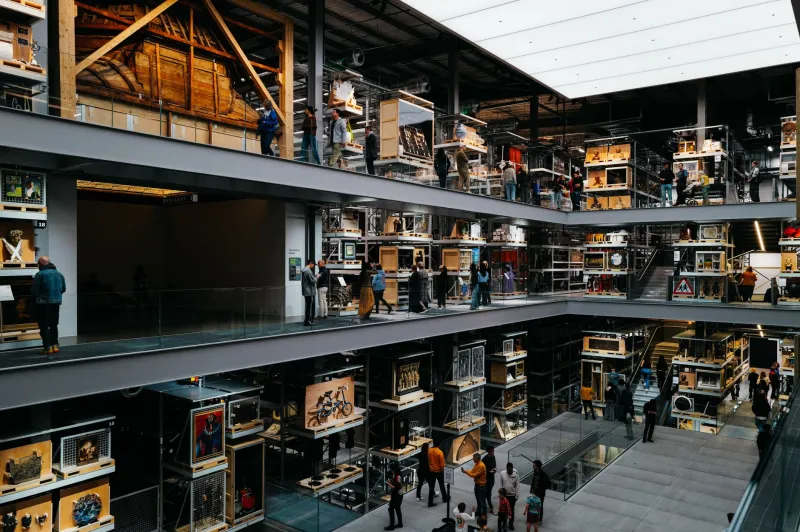
Israeli museums that address the same communities—Yemenite Jews, Moroccan Jews, Polish Jews, Ethiopian Jews—frame the immigration narrative around aliyah, the concept of ascent or return to the ancestral homeland. The Museum of the Jewish People (ANU) in Tel Aviv presents diaspora history as an extended prologue to Israeli nationhood, a curatorial choice that American visitors sometimes find reductive of the richness and self-sufficiency of diaspora cultures. Israeli curators, for their part, might observe that American presentations of the same communities similarly subordinate their complexity to a different national narrative.
Neither framing is false. Both are partial. The value of encountering an unfamiliar partiality is precisely that it makes visible the partiality one had previously taken for granted.
Archaeological Narrative and National Identity
Israeli archaeological museums present a further dimension of this interpretive divergence. The Israel Antiquities Authority and the institutions that display its findings operate within a scholarly framework that is internationally respected and methodologically rigorous. Yet the selection and presentation of archaeological material inevitably reflects national priorities.
American visitors with backgrounds in Near Eastern studies or biblical archaeology sometimes note that Israeli museum presentations of the Iron Age, the Second Temple period, or the Hasmonean dynasty carry an implicit continuity argument—connecting ancient Israelite civilization to modern Israeli statehood in ways that American academic archaeology might treat with greater caution. This is not unique to Israel; Greek museums present Hellenic antiquity through a lens of national continuity, and Egyptian institutions do the same with pharaonic civilization. But for American visitors who arrive without a framework for this practice, it can prompt productive questions about the relationship between archaeology and national legitimacy.
What Discomfort Teaches
The most valuable museum experiences are rarely the most comfortable ones. American visitors to Israeli cultural institutions who allow themselves to sit with the dissonance of encountering familiar history through an unfamiliar lens are engaging in a form of cultural literacy that no guidebook can fully prepare them for.
These encounters do not require the visitor to abandon their own interpretive framework. They require only a willingness to hold two perspectives simultaneously—to recognize that historical memory is always a construction, and that the construction one inhabits most naturally is not the only legitimate one. Israeli museums, for all their particularism, offer American visitors an unusually direct confrontation with this truth.