Threads of Identity: How Israeli Museums Are Safeguarding the Mediterranean's Rich Weaving and Embroidery Traditions
For many American visitors, Israel's cultural heritage conjures images of ancient scrolls, bronze-age pottery, and monumental archaeology. What fewer anticipate is the extraordinary world of textile art waiting inside the country's museums — a world where hand-stitched embroidery and hand-loomed fabric speak volumes about identity, migration, faith, and daily life across centuries of Mediterranean civilization. Israeli institutions are increasingly turning their attention to this fragile, luminous heritage, mounting ambitious preservation programs and gallery installations that reveal just how much history can be encoded in a single length of cloth.
A Fabric of Many Communities
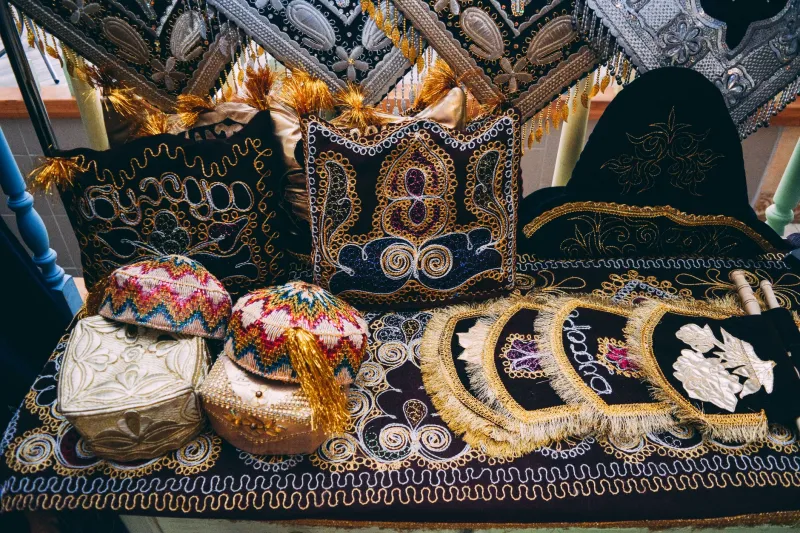
Israel's geographic position at the crossroads of Africa, Asia, and Europe has made it one of the most culturally layered territories on earth. The textile traditions that have evolved within its borders reflect that complexity in vivid detail. Bedouin women of the Negev Desert have long practiced a form of embroidery characterized by geometric precision and bold color contrast, each pattern carrying tribal and regional information that functions almost like a visual biography. Druze needlework, concentrated in the villages of the Galilee and the Carmel range, employs a distinct palette and symbolic vocabulary tied to the community's spiritual traditions. Palestinian thobe embroidery — the richly decorated dress that has become one of the most internationally recognized symbols of Palestinian cultural identity — varies dramatically from village to village, encoding geographic and social data within its patterns. Meanwhile, Jewish communities arriving from Yemen, Morocco, Iraq, and Central Asia brought with them textile traditions of equal complexity, from the gold-threaded ceremonial garments of Yemenite brides to the silk-woven prayer shawls of North African synagogues.
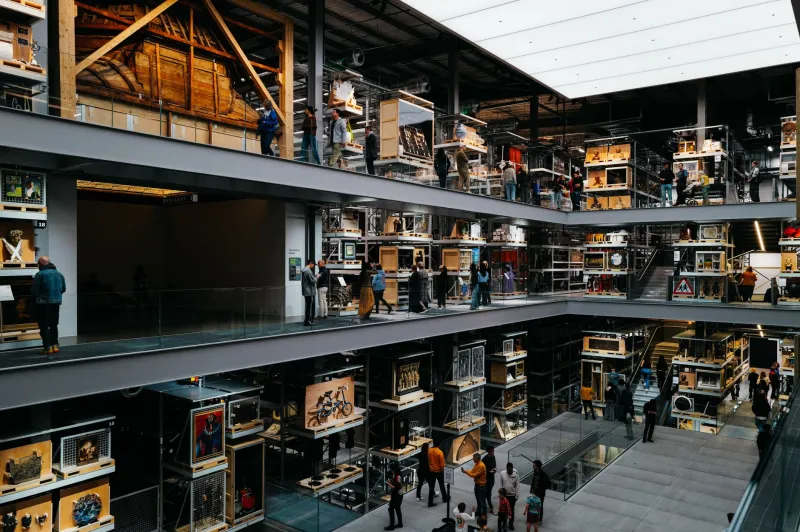
Museums across Israel have come to recognize that these traditions represent not merely aesthetic achievements but irreplaceable documentary records. The Israel Museum in Jerusalem holds one of the most significant textile collections in the region, encompassing thousands of garments, fragments, and ritual objects that span multiple centuries and dozens of communities. The collection includes pieces that document the material culture of communities now scattered across the globe, making the museum a repository of living history for diaspora populations as much as for Israeli citizens.
The Conservation Challenge
Preserving textiles presents conservators with a set of challenges that differ substantially from those encountered with stone, metal, or ceramic artifacts. Organic fibers are inherently vulnerable. Light degrades dyes and weakens thread structures. Humidity fluctuations cause expansion and contraction that can stress already fragile weaves. Insect damage, mold, and the chemical instability of certain historical dyes compound the problem. For conservators working with centuries-old embroideries, every decision about storage, display, and handling carries significant consequence.
Israeli conservation departments have developed sophisticated protocols to address these risks. Climate-controlled storage facilities maintain precise temperature and humidity levels year-round. Specially designed archival mounts support garments without placing stress on seams or embroidered panels. In gallery settings, ultraviolet-filtering glass and carefully calibrated artificial lighting protect displayed pieces from the photochemical damage that would otherwise accelerate their deterioration. Some institutions have adopted a rotation system for their most delicate holdings, displaying individual pieces for limited periods before returning them to climate-controlled storage.
Digital documentation has become an equally important tool. High-resolution imaging, including multispectral photography that can reveal faded patterns invisible to the naked eye, allows conservators to create detailed records that serve researchers, educators, and the communities from which the textiles originate. Several Israeli institutions have made portions of their digital textile archives accessible online, enabling diaspora community members in the United States and elsewhere to engage with objects that document their own cultural ancestry.
Partnering with Living Artisans
Perhaps the most compelling dimension of Israel's textile preservation effort is the growing recognition that conserving objects in storage and display cases is not, by itself, sufficient. The knowledge required to produce traditional textiles — the understanding of natural dyes, the command of complex weave structures, the memorized repertoire of regional embroidery patterns — exists not in any archive but in the hands and minds of living practitioners, most of whom are elderly. When those practitioners are gone, no amount of careful object conservation will be able to recover what has been lost.
In response, a number of Israeli museums and cultural organizations have established programs that bring master artisans into active partnership with institutional preservation efforts. The Sindyanna of Galilee cooperative, which works with Arab women artisans in northern Israel, has collaborated with cultural institutions to document traditional embroidery techniques through video recording and written instruction, creating educational resources that younger generations can access. At the Eretz Israel Museum in Tel Aviv, programming has incorporated live demonstrations and workshops in which visitors can observe and participate in traditional weaving and embroidery under the guidance of experienced practitioners. These initiatives transform the museum from a space of passive contemplation into a site of active cultural transmission.
Bedouin cultural centers in the Negev have pursued similar strategies, working to document the embroidery knowledge held by older women in their communities and to create structured opportunities for younger women to learn these skills in a context that honors their cultural significance. Some of these efforts have found institutional support from Israeli museums willing to acquire contemporary works produced within documented traditional frameworks, creating a market incentive that helps sustain the practice economically.
Reading the Patterns
For American visitors encountering these collections, one of the most rewarding aspects of engagement is learning to read textile patterns as a form of communication. Museum labels and interpretive materials at leading Israeli institutions increasingly provide this kind of guidance, explaining, for instance, that specific color combinations in Bedouin embroidery signal regional affiliation, or that the density and placement of embroidered panels on a Palestinian thobe indicate the social status and village of origin of its wearer. What initially appears as decorative abstraction resolves, with contextual knowledge, into a remarkably specific form of social text.
Jewish ceremonial textiles carry their own layered meanings. Torah ark curtains, bridal canopies, and Passover tablecloths produced by Jewish communities across the Mediterranean and Middle East frequently incorporate scriptural references, symbolic motifs, and dedicatory inscriptions that connect individual objects to specific moments in community and family history. Many such pieces in Israeli museum collections were brought to the country by immigrants in the mid-twentieth century, often representing the sole surviving material evidence of communities destroyed during the Holocaust or dispersed by political upheaval.
A Living Heritage
The textile galleries and conservation programs taking shape across Israel's museum landscape reflect a broader institutional commitment to the idea that cultural heritage is not merely something to be protected behind glass but something to be kept alive through active engagement. For American visitors planning a journey to Israel, these collections offer an entry point into the country's human complexity that complements the more familiar narratives of ancient history and religious significance.
To encounter a hand-embroidered Bedouin dress, a Yemenite bridal gown heavy with silver thread, or a Palestinian thobe whose patterns encode the memory of a specific village is to understand that the stories held within Israel's borders are far more numerous, and far more intricate, than any single visit can fully encompass. The museums working to preserve these threads of identity are performing an act of cultural stewardship whose value extends well beyond their own borders — and whose relevance to questions of heritage, community, and memory resonates deeply in the American context as well.