Words on the Wall: The Hidden Power of Museum Labels in Israel's Cultural Institutions
Most museum visitors read wall text quickly, if at all. A glance at the date, a skim of the provenance, perhaps a single sentence of context before moving on. Yet those few lines—chosen, revised, approved, and set in type by teams of curators, historians, and institutional communications professionals—carry an interpretive weight that far exceeds their modest appearance. In Israel's museums, where almost every artifact exists within living political and cultural debate, the language of the label is never incidental.
What a Label Is Actually Doing
At the most basic level, a museum label identifies an object: its material composition, approximate date, place of origin, and method of acquisition. But this descriptive function is only the surface layer. Beneath it, every label makes a series of choices about what constitutes relevant context, whose perspective is centered, and which historical frameworks are treated as self-evident rather than interpretive.
Consider the difference between describing a ceramic vessel as "Canaanite" versus "Israelite" versus "Bronze Age Levantine." Each designation reflects a distinct historiographical tradition, carries different implications for national and ethnic continuity, and positions the visitor within a particular understanding of the region's ancient past. None of these terms is simply neutral description. All three are arguments.
This is the terrain in which Israeli museum curators operate daily—and it is considerably more demanding than the equivalent work in, say, a natural history museum in Denver or a decorative arts institution in Philadelphia, where the interpretive stakes, while real, are rarely existential.
The Language of Continuity
At the Israel Museum's archaeology wing—one of the most significant archaeological collections in the world—labels frequently employ a vocabulary of continuity that traces an unbroken line between ancient material culture and the modern state. Objects from the Iron Age are sometimes described in terms that emphasize their relationship to biblical narrative, with phrases that treat the textual and the archaeological records as mutually reinforcing rather than methodologically distinct.
This is a meaningful interpretive choice. It reflects a long tradition within Israeli archaeology of treating the Hebrew Bible as a partially reliable historical source—a tradition that has been both productive and contested within the academic community. For the general visitor, however, the label does not announce itself as a position in an ongoing scholarly debate. It presents as established fact what is, in many cases, a matter of active disciplinary discussion.
Comparative institutions in other countries sometimes handle this differently. A British Museum label describing the same period might be more likely to flag the distinction between textual tradition and material evidence, framing the relationship as an open question. The Israeli label's tendency toward synthesis rather than qualification is not dishonest—it reflects a genuine interpretive tradition—but it is a choice, and a consequential one.
Naming, Omission, and the Politics of Place
Perhaps no dimension of Israeli museum labeling is more revealing than the treatment of place names. The question of how to designate geographic locations—particularly those in the West Bank and areas contested since 1948—produces some of the most carefully negotiated text in the country's cultural institutions.
Some institutions use exclusively modern Israeli place names for ancient sites, effectively collapsing the distinction between contemporary political geography and archaeological topography. Others employ dual naming conventions, listing both Hebrew and Arabic designations. A smaller number adopt the more academically conventional practice of using ancient or classical names that predate modern political categories entirely.
Each approach sends a distinct signal to the visitor. The choice to use only contemporary Israeli nomenclature implies a naturalness and historical continuity to the modern state's territorial organization. Dual naming acknowledges a more complex layering of cultural presence. The use of classical names attempts a kind of political neutrality that is itself, of course, a position.
For American visitors—many of whom arrive with limited familiarity with the geography in question—these choices shape the mental map they construct of the region, often without their awareness.
Framing the "Other" in Shared Spaces
Several Israeli institutions that address the history of multiple communities—Jewish, Arab, Christian, Druze—face the particular challenge of writing labels that do not implicitly privilege one community's experience as the primary narrative against which others are measured as variations or footnotes.
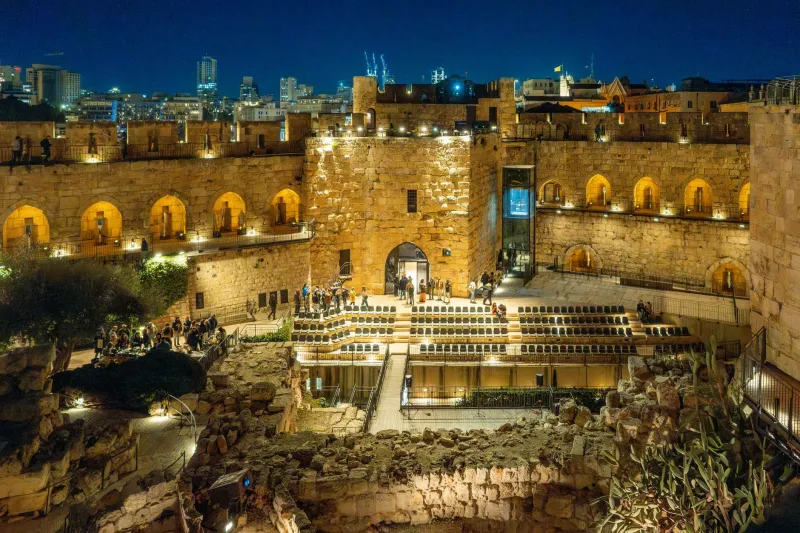
The Tower of David Museum in Jerusalem, which traces the city's history across multiple civilizations and conquests, has made notable efforts in recent years to present each historical period on its own terms rather than as a prelude to or interruption of a single continuous story. Labels in this institution tend to be more explicitly contextual, acknowledging that the same stones have been claimed, named, and interpreted differently by successive communities.
By contrast, some smaller regional museums—particularly those affiliated with specific settlement histories or memorial traditions—use label language that is frankly celebratory of particular communities and periods while treating others with considerably less interpretive generosity. This is not necessarily a failure of professional standards; it may reflect the institution's explicit mandate as a community museum rather than a scholarly one. But it is worth noting as a pattern.
What Visitors Can Learn from Reading Carefully
For the attentive visitor, Israeli museum labels offer something beyond the information they contain: they offer a window into how a society narrates itself to itself and to the world. The word choices, the frameworks, the silences—all of these are data points in understanding how a living culture manages its relationship to a densely inhabited past.
American visitors, in particular, may find this dimension of the museum experience unfamiliar. US institutions have their own interpretive traditions and blind spots, of course, but they operate within a somewhat different set of historical pressures. Reading Israeli museum labels with genuine attention—asking not only what they say but why they say it that way—transforms the museum visit from passive reception to active inquiry.
This, perhaps more than any single artifact or exhibition, is what Israel's museums have to offer the curious visitor: an education in the art of reading a story that is still being written.